Posts

Showing posts with the label MIMO

What Is The Next for Mobile System Design? I: A Single-Cell Model Perspective on Downlinks

Image
Interference Cancellation: A Short Overview How to Broadcast Multimedia Contents? [Note] Due to the asymmetry between the uplinks and downlinks of a mobile network, there are different considerations, tradeoffs and techniques for designing each directions. In general, with the recent advance on uplink interference cancellation and management techniques, mobile network is usually limited by downlinks due inter-cell interference, especially when delay is a key part of the equation. On this blog, my focus will be on downlinks. How to evolve mobile system uplinks will be discussed in separated blogs. Mobile system design usually starts from our understanding of wireless channels and the services customers are demanding. The properties of various wireless channels can help us understand the system design limitation we are facing and the potentials we may achieve.  For example, COST 231 model, which was developed by European COST Action 231. Its variations are the most popular...

How Much Feedback Is Enough for MIMO? VI Rank Deficiency

Image
[How Much Feedback Is Enough for MIMO? I Introduction] [How Much Feedback Is Enough for MIMO? II Channel Estimation] [How Much Feedback Is Enough for MIMO? III Codebook Design] [How Much Feedback Is Enough for MIMO? IV Channel Quantization] [How Much Feedback Is Enough for MIMO? V Feedback Reliabilities] [3GPP2 TSG-C WG3 C30-20090511-030] [3GPP2 TSG-C WG3 C30-20090511-032] The adoption of multi-antenna techniques is believed to be able to provide additional antenna gain, diversity gain, multiplexing gain and interference cancellation gain. They can help improve link quality and increase link throughput. Multi-antenna techniques are believed to be critical in meeting the demand of high data rate and high link quality and can be employed for both forward link and reverse link transmission. However, there are many issues which should be carefully considered when multi-antenna techniques are implemented. These issues include the rank deficiency of actual MI...

How Much Feedback Is Enough for MIMO? I Introduction

Image
[How Much Feedback Is Enough for MIMO? II Channel Estimation] [How Much Feedback Is Enough for MIMO? III Codebook Design] [How Much Feedback Is Enough for MIMO? IV Channel Quantization] [How Much Feedback Is Enough for MIMO? V Feedback Reliabilities] [How Much Feedback Is Enough for MIMO? VI Rank Deficiency] Figure 1. MIMO model with feedback Multi-antenna systems have received much attention over the last decades, due to their promise of higher spectrum efficiency with no transmit power increase. Combining multiantenna transceiver with relay network is essential not only to provide comprehensive coverage but also to help relieve co-channel interference in existing wireless systems in a cost effective fashion. For multiple-input multiple-output (MIMO) transmission, it is well-known that their performance and complexity can be improved by making channel state information (CSI) available at the transmitter side. This is usually achieved through a reverselink CSI feedback channe...

How to Broadcast Multimedia Contents? II Lessons from The Channel

Image
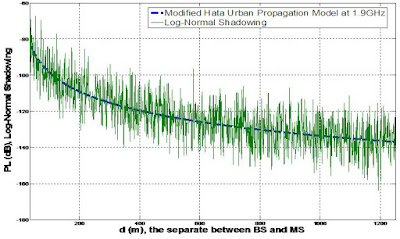
What Is The Next for Mobile System Design? I A Single-Cell Model Perspective on Downlinks [How to Broadcast Multimedia Contents? I Introduction] [How to Broadcast Multimedia Contents? IV Hierarchical Modulation] [How to Broadcast Multimedia Contents? V Overloaded Transmission and IC] [How to Broadcast Multimedia Contents? VI Open-Loop MIMO for BCMCS] [How to Broadcast Multimedia Contents? VII Network Layer or Stream Layer Design] COST 231 model, which was developed by European COST Action 231, and its variations are the most popular radio propagation model adopted in various standardization bodies, such as 3GPP, 3GPP2 and IEEE. Its modifications include COST 231-Hata Model and COST 231-Walfisch-Ikegami Model . The mathematical formulation of the COST 231-Hata model path loss in dB is PL = 46.3 + 33.9 logf - 13.82log h BS - a( h MS ) + [ 44.9-6.55logh BS ] log d + C which features a carrier frequency f between 800MHz and 2GHz, an above-neighborhood base station antenna w...

How to Broadcast Multimedia Contents? I Introduction

Image
What Is The Next for Mobile System Design? I A Single-Cell Model Perspective on Downlinks [How to Broadcast Multimedia Contents? II Lessons from The Channel] [How to Broadcast Multimedia Contents? IV Hierarchical Modulation] [How to Broadcast Multimedia Contents? V Overloaded Transmission and IC] [How to Broadcast Multimedia Contents? VI Open-Loop MIMO for BCMCS] [How to Broadcast Multimedia Contents? VII Network Layer or Steam Layer Design] Broadcast multicast service (BCMCS) has increasingly been popular for delivering multimedia content to mobile users. Traditional digital broadcast air interfaces are designed with the tradeoff between maximum achievable rate and intended coverage in mind. The actual rates are usually limited by the maximum transmit power and the worst channel condition so that every user in coverage can reliably receive the services as well as contents of same quality. The users under good reception condition may have no advantage, even if their potential ...