Posts

H.264 Network Abstract Layer Header

RTP Packetization for H.264 NAL Units How to Broadcast Multimedia Contents? H.264 encoder is composed of two layers, video coding layer (VCL) and network abstraction layer (NAL). VCL translates the video information into bits streams. Since the underlying transportation layers are diversified, NAL maps VCL bitstreams into byte-oriented transportation-layer-friendly and HDLC-like NAL units prior to delivery. During the mapping of VCL bitstreams to NAL units, at least three operations are done, which are byte alignment, emulation prevention, framing with an additional one-byte NAL unit header. The first byte after a NAL unit start code prefix is the NAL unit header. A NAL unit header consists of  three fields. forbidden_bit (1 bit) : may be used to indicate a NAL unit is corrupted or not. nal_storage_idc (2 bit) : signals relative importance, and if the picture is stored in the reference picture buffer.  nal_unit_type (5 bit) : signals 1 ...
How to Broadcast Multimedia Contents? II Lessons from The Channel

Image
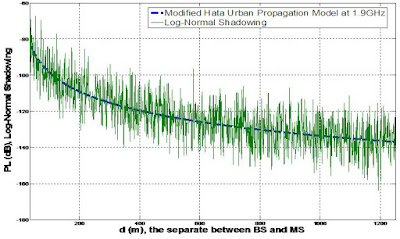
What Is The Next for Mobile System Design? I A Single-Cell Model Perspective on Downlinks [How to Broadcast Multimedia Contents? I Introduction] [How to Broadcast Multimedia Contents? IV Hierarchical Modulation] [How to Broadcast Multimedia Contents? V Overloaded Transmission and IC] [How to Broadcast Multimedia Contents? VI Open-Loop MIMO for BCMCS] [How to Broadcast Multimedia Contents? VII Network Layer or Stream Layer Design] COST 231 model, which was developed by European COST Action 231, and its variations are the most popular radio propagation model adopted in various standardization bodies, such as 3GPP, 3GPP2 and IEEE. Its modifications include COST 231-Hata Model and COST 231-Walfisch-Ikegami Model . The mathematical formulation of the COST 231-Hata model path loss in dB is PL = 46.3 + 33.9 logf - 13.82log h BS - a( h MS ) + [ 44.9-6.55logh BS ] log d + C which features a carrier frequency f between 800MHz and 2GHz, an above-neighborhood base station antenna w...

How to Broadcast Multimedia Contents? I Introduction

Image
What Is The Next for Mobile System Design? I A Single-Cell Model Perspective on Downlinks [How to Broadcast Multimedia Contents? II Lessons from The Channel] [How to Broadcast Multimedia Contents? IV Hierarchical Modulation] [How to Broadcast Multimedia Contents? V Overloaded Transmission and IC] [How to Broadcast Multimedia Contents? VI Open-Loop MIMO for BCMCS] [How to Broadcast Multimedia Contents? VII Network Layer or Steam Layer Design] Broadcast multicast service (BCMCS) has increasingly been popular for delivering multimedia content to mobile users. Traditional digital broadcast air interfaces are designed with the tradeoff between maximum achievable rate and intended coverage in mind. The actual rates are usually limited by the maximum transmit power and the worst channel condition so that every user in coverage can reliably receive the services as well as contents of same quality. The users under good reception condition may have no advantage, even if their potential ...

Location Based Services for Mobiles II: GPS, Assisted GPS and Network Assisted GPS

Image
[IEEE C802.16m-08/1105 Network Assisted GPS (N-GPS) Positioning in WiMAX/16m] [Location Based Service for Mobiles I: Technologies and Standards] GPS - Global Positioning System Figure 1. GPS System Archiecture: Space Segment, Control Segment and User Segment GPS is a Global Navigation Satellite System for determining the positions of receivers using signals broadcast by satellites.  It was developed and operated by US government to enhance the effectiveness of allied and US military forces.  The first experimental Block-I GPS satellite was launched in 1978. Since 1983, GPS has become an aid to civilian navigation worldwide, and a useful tool for survey, commerce, and scientific uses.  As of September 2007, there are 31 actively broadcasting satellites in the GPS constellation.  Satellites orbit 20,163 kilometers above the earth at 3.87 km/s.  6 orbital planes, each with 4+ satellites. Typically 6 to 12 satellites are visible from any plac...

Location Based Services for Mobiles I: Technologies and Standards

[Tutorial in IEEE International Conference on Communications (ICC) 2008] [Location Based Services for Mobiles II: GPS, Assisted GPS and Network Assisted GPS] [How to Improve Forward Link Positioning ... ? I. Introduction] [How to Improve Forward Link Positioning ... ? II. Hearability and Accuracy] [1x HDP Enhancements] [Enhanced Location Based Services Support in cdma2000] [IEEE C802.16m-08/1106 Enhance Downlink Positioning in WiMAX/16m] [IEEE C802.16m-08/1105 Network Assisted GPS (N-GPS) Positioning in WiMAX/16m] Location based services (LBS) for mobile are the services supported by cellular networks for providing mobile users with various location sensitive applications such as E911, Friendfinder, personalized advertisement, etc. LBS accelerate the convergence of 3C (computer, communication and consumer electronics). One aspect of LBS market is the rapid growth of GPS market, which is predicted to reach $28.9 billion by 2010 by GPS World. It is believed that LBS is bringing...